Showing posts with label standard model. Show all posts

Thursday, January 12, 2012

Introduction to the Standard Model Part 2: The Higgs boson

One of the bosons predicted by the Standard Model that still has not been found yet is the Higgs boson.  Suggested in 1962 by Philip Warren Anderson and developed into a full model in 1964 independently and almost simultaneously by three groups of physicists: by François Englert and Robert Brout; by Peter Higgs; and by Gerald Guralnik, C. R. Hagen, and Tom Kibble.

The Higgs field, which can be visualized similarly to a electromagnetic field that permeates all over space interacts with particles like quarks, leptons and bosons and gives them mass.

Illustration: Picture the blue coloured people in the party as Higgs bosons.

When a famous politician or celebrity enters the room, the people crowd around her and makes her movement slower.
In the illustrations used above, we can imagine that as a particle interacts with the Higgs field more, it gains more mass, hence becomes heavier.  Massless particles like the gluons and photons theoretically do not interact with the Higgs field hence it will be like an unimportant person in the party that passes through unnoticed.

Many particle accelerators and detectors have participated in the search for this particle.  The accelerators LEP, Tevatron, were looking for signs of this particle and presently the LHC has made this its primary mission with detectors ATLAS and CMS competing with each other for the coveted prize of who will find it first.  In December 2012, there was an update about the search status so far.

If the Higgs is light, in the mass region of 100-600 GeV, then there will be an interesting problem such that radiative corrections to the boson will result in a naturalness or fine-tuning problem.  There will then be room for an elegant theory of Supersymmetry that can be introduced to fix this.


The video title is What's new @CERN ? Higgs boson, standard model, SUSY and neutrinos.


Tuesday, October 11, 2011

Trying to understand it all: The Standard Model Part 1

Source: PBS NOVA, Fermilab, PDG
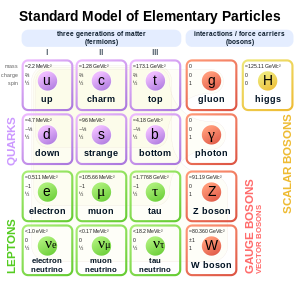
The Standard Model of Particle Physics is the best model we have so far that describes matter and forces.  It took the combined effort of physicists spanning over more than half of the past century to come up with a theory that ties seemingly different things together.  In the figure on the left, there seemed to be a random combination of greek letters and some physics jargon about fermions and bosons.  If you have done some particle physics, you will disagree with the previous statement.

Anyway, you may also have realized that there are three 'kinds' of 'stuff' represented by the different colours: purple, green and red.  All the matter we can see, feel and detect so far (observable) are made from the 'elements' in the diagram.  The ones in the purple box, physicists call them quarks, green ones leptons and red ones exchange particles.  For example the proton, which makes up part of an atom's nucleus is made from two u-quarks and one d-quark.  The neutron, is made up of one up-quark and two down-quarks instead.  Then we also have electrons that usually orbit around the nucleus of the atom.  Electrons belong to the lepton (green) group.

Now, we have only talked about baryons (subatomic particles that consists of three quarks or antiquarks).  In 1935, Hideki Yukawa theorized the existence of the mesons as exchange particles for the strong nuclear force.  This idea was proven to be not true as the real exchange (or carrier) particle for the strong nuclear force is the gluon.  The first mesons (made from only two quarks or antiquarks), the pions (made from an u-quark and d-antiquark) was found in 1947 by Cecil Powell, César Lattes, Giuseppe Occhialini et.al. from cosmic rays.  Subsequent experiments detected charged pions and the neutral pion.

The strong nuclear force is mediated by the gluon between quarks and antiquarks in the proton, neutron for example.  They bind the quarks together so hard we never get to see any 'naked' quarks in nature.  Everytime you pull the quarks apart and when you think you put in enough energy to split them, they convert that energy into a quark-antiquark pair and you get two mesons or baryons.
Pulling on the quark pairs in mesons create even more
mesons, resulting in a mess (jet) of particles.
Source: Wikipedia