Showing posts with label particle physics. Show all posts

Thursday, January 12, 2012

Introduction to the Standard Model Part 2: The Higgs boson

One of the bosons predicted by the Standard Model that still has not been found yet is the Higgs boson.  Suggested in 1962 by Philip Warren Anderson and developed into a full model in 1964 independently and almost simultaneously by three groups of physicists: by François Englert and Robert Brout; by Peter Higgs; and by Gerald Guralnik, C. R. Hagen, and Tom Kibble.

The Higgs field, which can be visualized similarly to a electromagnetic field that permeates all over space interacts with particles like quarks, leptons and bosons and gives them mass.

Illustration: Picture the blue coloured people in the party as Higgs bosons.

When a famous politician or celebrity enters the room, the people crowd around her and makes her movement slower.
In the illustrations used above, we can imagine that as a particle interacts with the Higgs field more, it gains more mass, hence becomes heavier.  Massless particles like the gluons and photons theoretically do not interact with the Higgs field hence it will be like an unimportant person in the party that passes through unnoticed.

Many particle accelerators and detectors have participated in the search for this particle.  The accelerators LEP, Tevatron, were looking for signs of this particle and presently the LHC has made this its primary mission with detectors ATLAS and CMS competing with each other for the coveted prize of who will find it first.  In December 2012, there was an update about the search status so far.

If the Higgs is light, in the mass region of 100-600 GeV, then there will be an interesting problem such that radiative corrections to the boson will result in a naturalness or fine-tuning problem.  There will then be room for an elegant theory of Supersymmetry that can be introduced to fix this.


The video title is What's new @CERN ? Higgs boson, standard model, SUSY and neutrinos.


Wednesday, December 14, 2011

the elusive Higgs boson

All theorized particles in the Standard Model of Particle Physics has been found except the Higgs boson. A confirmation of the existence of this particle will complete the theoretical description of over half a century of experimental and theoretical particle physics work. Yesterday, the combined data from the ATLAS (4.9 fb-1) and CMS experiments were shown in a public seminar from CERN hinting that the Higgs exists with a mass of about 126GeV(as a comparison, the mass of the proton is 0.938GeV).
Invariant mass distribution for the inclusive data sample, overlaid with the sum of the background-only fits in different categories described in Sections 3 and 4 in the ATLAS paper and the signal expectation for a mass hypothesis of 120 GeV corresponding to the SM cross section. The figure below displays the residual of the data with respect to the background-only fit sum. Source: ATLAS Collaboration
 As shown in the figure above, the dotted lines show how the Higgs would modify the Standard Model background.  It is a very minor modification so it requires high sensitivity of the detector.
The observed and expected 95% confidence level limits, normalised to the SM Higgs boson cross sections, as a function of the hypothesized Higgs boson mass. Source: ATLAS Collaboration.

We only see a 3.6σ(ATLAS) and 2.6σ(CMS) above the expected SM background for the Higgs mass of 126GeV in the figure above.  A 5σ significance is required to claim a discovery.

(to answer Mr. Hawkin's question) Do I want the Higgs to exist? Well, its kind of nice to have a theory being proven correct by experiment especially it involved the hard work of many generations of physicists.  Having the Higgs to exist at the low mass region of 115-150GeV would also be nice.  There will be other problems that physicists could work on and more work for me to do, supersymmetry maybe?

On the other hand, no Higgs means a totally different theory to explain where mass comes from.  Although there are already many theories like Technicolor or Higgless SM models, we will always have more work to do.

Tuesday, October 11, 2011

Trying to understand it all: The Standard Model Part 1

Source: PBS NOVA, Fermilab, PDG
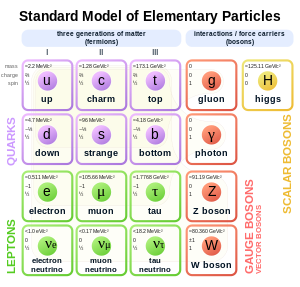
The Standard Model of Particle Physics is the best model we have so far that describes matter and forces.  It took the combined effort of physicists spanning over more than half of the past century to come up with a theory that ties seemingly different things together.  In the figure on the left, there seemed to be a random combination of greek letters and some physics jargon about fermions and bosons.  If you have done some particle physics, you will disagree with the previous statement.

Anyway, you may also have realized that there are three 'kinds' of 'stuff' represented by the different colours: purple, green and red.  All the matter we can see, feel and detect so far (observable) are made from the 'elements' in the diagram.  The ones in the purple box, physicists call them quarks, green ones leptons and red ones exchange particles.  For example the proton, which makes up part of an atom's nucleus is made from two u-quarks and one d-quark.  The neutron, is made up of one up-quark and two down-quarks instead.  Then we also have electrons that usually orbit around the nucleus of the atom.  Electrons belong to the lepton (green) group.

Now, we have only talked about baryons (subatomic particles that consists of three quarks or antiquarks).  In 1935, Hideki Yukawa theorized the existence of the mesons as exchange particles for the strong nuclear force.  This idea was proven to be not true as the real exchange (or carrier) particle for the strong nuclear force is the gluon.  The first mesons (made from only two quarks or antiquarks), the pions (made from an u-quark and d-antiquark) was found in 1947 by Cecil Powell, César Lattes, Giuseppe Occhialini et.al. from cosmic rays.  Subsequent experiments detected charged pions and the neutral pion.

The strong nuclear force is mediated by the gluon between quarks and antiquarks in the proton, neutron for example.  They bind the quarks together so hard we never get to see any 'naked' quarks in nature.  Everytime you pull the quarks apart and when you think you put in enough energy to split them, they convert that energy into a quark-antiquark pair and you get two mesons or baryons.
Pulling on the quark pairs in mesons create even more
mesons, resulting in a mess (jet) of particles.
Source: Wikipedia

Saturday, October 01, 2011

What's next: After Tevatron


On October 13, 1985 at Fermilab, the Tevatron produced protons and antiprotons collisions inside the CDF detector for the very first time. It was a magical day for the few dozen people in the accelerator and CDF control rooms. Since that day, literally billions of matter-antimatter collisions took place inside CDF and then inside CDF and DZero. What was once novel is now routine – and routine at an unprecedented scale. The intensity of the beams gradually multiplied, thanks to the relentless efforts of the Tevatron accelerator physicists.
Friday at 2 p.m., after nearly 26 years of operation, a switch will be turned, ending the career of one of the most remarkably successful colliders ever in particle physics. The Tevatron collider established a brand identity for Fermilab and changed the physics landscape forever... 
- Rob Roser and Giovanni Punzi, Fermilab
Tevatron.  Courtesy: Fermilab
The Tevatron has it share of important particle physics discoveries.  It has been said that the accelerator has done its job well.  It accomplished what it was built for.  However, physicists were a bit disappointed since they could not get a whiff of new physics from the Tevatron, or at least find the Higgs boson.

The Tevatron hosted two detectors, CDF and D0.  Both the CDF and D0 detector takes snapshots of the particles that emerge when protons and antiprotons collide.  This collision produces a gezillion amount of particles that physicists will have to sieve through and find the ones that we have never seen before.  The Tevatron discovered

  • the top quark and determined its mass to a high precision
  • two distinct production mechanisms for the top quark: pair and single production
  • five B baryons (2 cascade, 1 omega and 2 sigma _b)
  • Bc meson
  • Y(4140), a new quark structure
  • Bs oscillation

source: Fermilab

So now, it is up to the LHC@Cern to find the Higgs boson, or something to replace it.  For the near future, the data generated by the Tevatron will be analyzed by physicists.  A new accelerator research center will also be built at the CDF site.  For those interested to watch the closing ceremony, here is the link.  The show starts at 2pm GMT-5.

Note:  Top quarks are very massive, as heavy as a Gold atom. It requires large amounts of energy are needed to create one and the only way to achieve such high energies is through high energy collisions. These occur naturally in the Earth's upper atmosphere as cosmic rays collide with particles in the air, or can be created in a particle accelerator. As of 2011, the only operational accelerators that generate beams of sufficient energy to produce top quarks are the Tevatron at Fermilab, in which protons and antiprotons are collided and the Large Hadron Collider at CERN.

Friday, September 30, 2011

What's smaller than a proton?

A proton, made of two up quarks and a
down quark
Since Rutherford's scattering experiment with gold and alpha particles (that came from the decay of radium) that proved the atomic nucleus had minute size and a positive charge, we have came a long way in understanding the atom and fundamental particles that make up our universe and ourselves.  We now know with reasonable doubt that the atom is made up tiny point-like electrons orbiting a nucleus of protons and neutrons (except the hydrogen atom of course).

One classification of one type of
baryons (particles made of three quarks).
Mesons on the other hand are made
of one quark and one anti-quark.
Courtesy of Fermilab
Entering the second half of the 20th century, particle physicists discovered a zoo of 'elementary' particles, pions, kaons, J/ψ, and many others.  They thought nature would not be so complicated and they sought out a theory to explain the existence of these particles.  Similar to the work done on the periodic table of elements, using the proton number to order the elements, Murray Gell-Mann and Yuval Ne'eman independently suggested a theory to explain that all the 'elementary' particles are not so elementary after all.  The problem with theory is that although it was able to explain the particle zoo, quarks were never seen before.  They were never created and observed in the laboratory.

SLAC, USA
Ok, so if we can't create and see them, how are we so sure they exist?  Particle physicists have shot protons with high energy electron beams to show that they actually are composite, e.g. made up of quarks.  At the Stanford Linear Accelerator (SLAC), they repeated the earlier Rutherford experiment but the target was now a proton and the beam an electron.  The results showed that the electron moved in a way that suggested that the proton was not a point particle.  At even higher electron energies, they see the electron move (scatter at an angle) even more.  This proved, like how Rutherford proved that there was localized structured in the atom, that there were substructure in the proton.  We now call them quarks (Feynman called them partons).

Other experiments like HERA in Hamburg, Germany also studied the structure of the proton.  In addition to the two up-quark and one down-quark we say made up the proton, there is a sea of quarks, or rather valence quarks (analogous to the valence electrons orbiting the atom).  
Our current picture of the proton.  It
consists of quarks, antiquarks and
gluons.
These pairs of quarks and anti-quarks exist only momentarily; formed from an energetic gluon, they will come back together and annihilate returning once again to a gluon.  They probed to the smallest visibility and saw up to 100 of these quark/anti-quark pairs at any instant.


I just used the word 'gluon' without explaining.  Basically it is something that gets passed around between quarks when they interact.  You do not see them directly too.  Strange how particle physics has evolved right?


I'm flying back to Sweden tonight.  Looks like I am going to miss the sun and the windless weather in Meyrin for the colder air of Lund.  Update:  Flight got redirected to Frankfurt before going to Copenhagen.  Looks like I get to see some of Germany today.

Saturday, September 24, 2011

Faster-than-light neutrinos?

Just about two hours ago in CERN, there was a groundbreaking claim about an experiment detecting neutrinos that travel faster than light.  The OPERA experiment in Gran Sasso, Italy collected data and analysed the speed of these tiny particles that only interact gravitationally and weakly since neutrinos are neutral leptons.  They have shown in their experiment that the speed of the neutrinos were faster than light by a factor of

(2.48 ± 0.28 (statistical errors) ± 0.30 (systematic errors) ) ×10^-5

or 6.0 σ.  It is big news all over the world with major news networks(for example, BBC) reporting them on webpages and TV channels.
The auditorium room filling up half and hour before the seminar starts.
I am really lucky to get a seat at the back  row!

The speaker, Dario Autiero (Institut de Physique Nucleaire de Lyon)


So what are neutrinos?  Originally, they are postulated to exist by Wolfgang Pauli to explain missing transverse energy of beta decay.  A simple representative decay process would be neutron decay.


But then when they measured the energy of the beta particle, or the fast electron, they found that the reaction did not obey the Law of Conservation of Energy.  So W. Pauli thought that maybe there is some kind of small undetected particle that carried that energy away.  Now we know to reasonable doubt that this is true so we rewrite this decay process as


Now that we got rid of the basic question of what neutrinos really are, you may ask, what was OPERA's experiment about?  Well, OPERA was trying to catch neutrinos that change flavours.  Flavours?  We now know that there are three flavours.  The electron neutrino, muon neutrino and the tau neutrino and by changing flavours (or the technical term is neutrino oscillation) the electron neutrino changes in the muon or tau neutrino.  The OPERA experiment is an appearance experiment; to detect the appearance of tau neutrinos from the oscillation of muon neutrinos sent from CERN.

They are still looking for tau neutrinos right now.  At the same time, they need some kind of accurate measurements of distance and time since the travel time from CERN to Gran Sasso, Italy (730km) took the muon neutrinos only 3ms.  They used GPS synchronizations for timing and help from land surveying to figure out the distance accurate to the centimeter level.  According to them, after months of checking and rechecking their results they decided that their experimental results and analysis work were correct and decided to show it to the world.  In particle physics, it is enough to claim discovery with a 5.0 σ significance (signal over background events).

The CERN Neutrinos to Gran Sasso (CNGS) beam line.  It produces muon neutrinos from a proton beam source accelerated  by the proton synchrotron in CERN.  The protons hit a target producing pions and kaons that decay into muons and neutrinos.  The neutrinos then pass through 730km of earth and rock to reach the OPERA experiment in Italy.    They could do that because they very rarely interact with matter.

Friday, September 23, 2011

What is particle physics?

Today, I boarded a flight to Geneva from Copenhagen, and arrived at CERN roughly about noon time.  The weather was the total opposite of the Lund's where it has been cloudy, rainy and windy the past few weeks if not most of summer.  The sun was terrific and warm which reminded me so much about the trip I had in Italy.

CERN is located in the part of Geneva called Meyrin, which is really at the border with France.  For the uninitiated, CERN is a major research center for major discoveries in the field of particle physics.  In the past, it has contributed to the discovery of
  • 1973: The discovery of neutral currents in the Gargamelle bubble chamber.
  • 1983: The discovery of W and Z bosons in the UA1 and UA2 experiments.
  • 1989: The determination of the number of light neutrino families at the Large Electron–Positron Collider (LEP) operating on the Z boson peak.
  • 1995: The first creation of antihydrogen atoms in the PS210 experiment.
  • 1999: The discovery of direct CP-violation in the NA48 experiment.
  • 2010: The isolation of 38 atoms of anti-hydrogen.
  • 2011: Maintaining anti-hydrogen for over 15 minutes.
source: wikipedia

These experiments have increased our knowledge of what forms matter and how they interact with each other.  Current experiments that have been followed by the media are ATLAS, CMS, ALICE amongst others.  They are discovery machines that find new physics, which sometimes mean new particles or new properties of matter.  The Higgs boson is one of the most talked about but however till now, it has not been discovered yet.  Other hypothetical particles waiting to be discovered are like the sparticles; neutralinos, charginos and squarks.

The CERN research complex looks like an industrial area with a smattering of workshops and warehouses.  Ocassionally you find some art pieces, which are actually decommissioned detector pieces like the Gargamelle bubble chamber.  There are also two beam pipes used as banner placeholders and you will see in the pictures.  In 2000, the Swiss built and object for the World Expo in Hannover.  This object has then been transplanted to the CERN site and is called the Globe of Science and Innovation, and it one of the donated art pieces which is slowly becoming a landmark icon (according to the CERN site, but if you visit, it definitely catches your eye orders of magnitude higher than the boring 70's type architecture of the CERN buildings).
The CERN signboard outside Entrance B
Where all the accelerator actions happens.

... so the beam from SPS goes to LEP then LHC ...

All is calm in the control room.  No beams running yet.


Sample beam pipe or rather drift tubes.

The cafeteria that is chaotic at lunch time.  Reminds me much about the canteens in NUS.

This picture and the previous one was once a piston activated bubble chamber.

The interior of the bubble chamber, which is a particle detector.


The Gargamelle detector.  The one that discovered the neutral current.


A Van deGraff generator.  The first step in accelerating charged particles in the old days.


The Globe of Science and Innovation on the opposite side of the road from CERN.

Can you see Mont Blanc.

The ATLAS control room building.  You can tell from the mural of the cross section of the detector on the wall.